There is a way of travelling that you recognise before you can describe it. A grey nylon bag in a sunlit corridor of Copenhagen Airport. A black case set neatly beside a wooden bench at Kyoto Station. A white shirt, dark trousers, no jewellery, no logos. The traveller looks unhurried and slightly underdressed, in the way that the most expensive things often do. This is the minimalist travel aesthetic, and the more you look at it, the more you see that it is less about appearance than about temperament.
It is not the same as packing light, though packing light tends to follow. It is not the same as quiet luxury, though it borrows from it. It is closer to a way of choosing — a refusal to surround oneself with the wrong things, in the wrong colours, in the wrong volumes. What is left is calmer than what is removed.
The principle: subtraction, not addition
Most travel content is additive. More gadgets, more compartments, more colours, more pockets. The minimalist register works in the opposite direction. It begins by asking what can be left behind without loss, and what can be left behind with gain. The answer is usually: most of it.
A bag in this register has the fewest visible details that still let it function. A wardrobe has the fewest pieces that still cover every situation. A travel kit has the fewest objects that still cover every contingency. The discipline is not in choosing what to bring; it is in not choosing what to bring, again and again, until what remains is obvious.
Materials and palette
The aesthetic has a narrow material vocabulary. Recycled nylon with a silky finish. Polycarbonate in matte black or dark slate. Waxed cotton canvas, when texture is wanted. Wool. Leather, sparingly. Glass and ceramic in the room. Nothing glossy. Nothing branded. Nothing that announces itself before it is touched.
The palette is even narrower. Black, dark slate, ink, off-white, and one neutral that a person can call their own — usually grey, olive, or stone. Anything beyond this earns its place by being old, made by hand, or carried for a reason. New things in saturated colours rarely make the cut.
Cities the aesthetic comes from
You can trace the look to a few specific places. Tokyo and Kyoto, where restraint is older than modernism and where the line between a museum and a corner shop can be thin. Stockholm and Copenhagen, where designers learned long ago that warm wood, cold light, and quiet textiles are enough. Berlin, which prefers concrete and matte black to anything that tries too hard. Lisbon, which adds soft light and a little patina to the same idea. Milan and Antwerp, for the tailoring. Each of these cities punishes overdesign and rewards the well-considered absence.
Travellers who care about the aesthetic tend to plan trips around these places, or around their quieter neighbourhoods elsewhere — the SoFo district in Stockholm, Shibuya in Tokyo, Mitte in Berlin, Príncipe Real in Lisbon. The bag travels through them and inherits something of their register.
The objects
Gion: structure as restraint
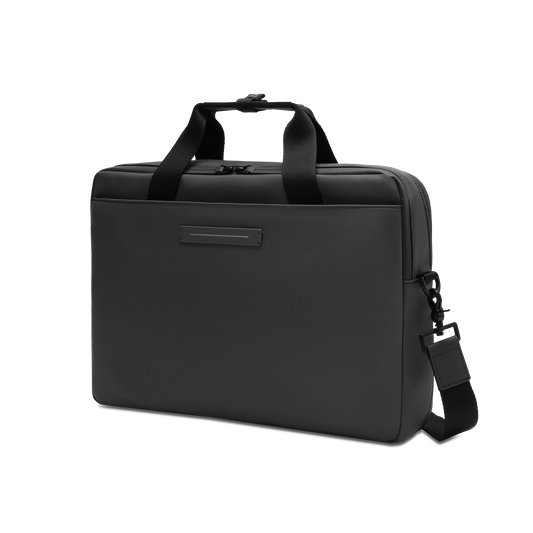
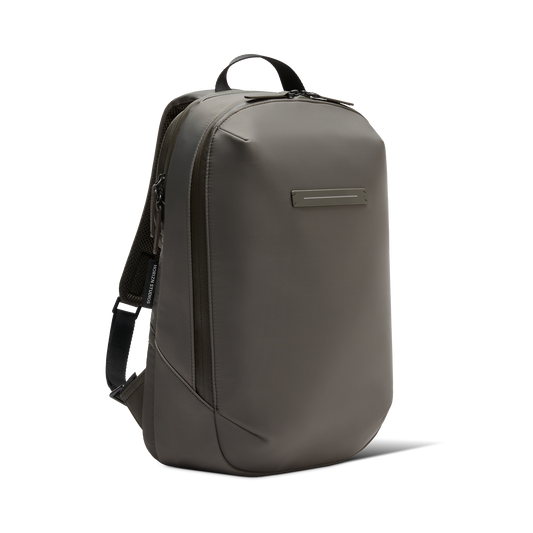
The Gion line is the everyday expression of the aesthetic. The bags are made from high-end recycled nylon with a clean silhouette and visible discipline in the seams. There is no surface decoration. The black is a serious black, neither glossy nor warm. The lines are straight where they should be straight and softened where they need to drape.
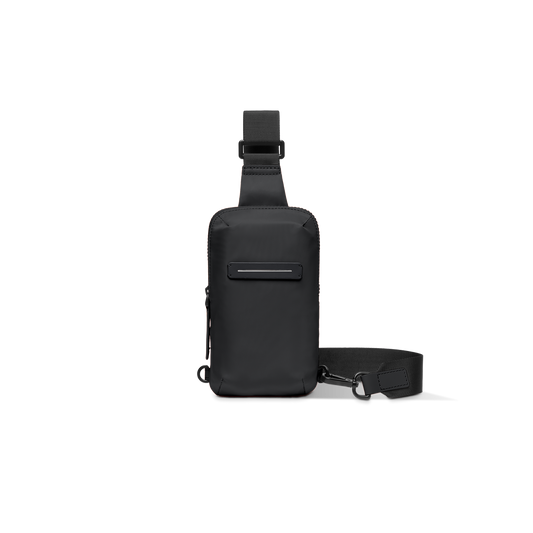
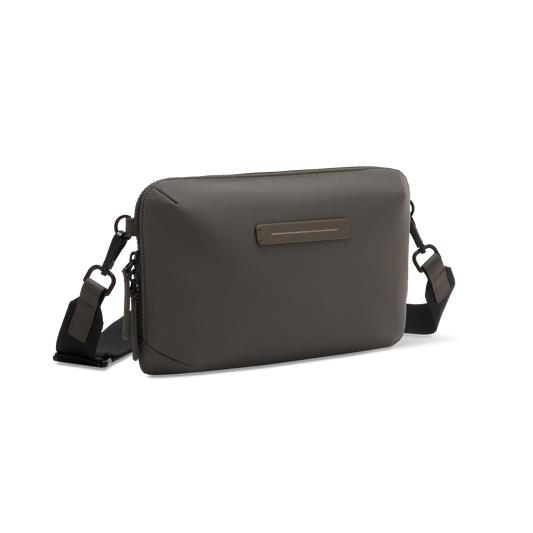
The Gion Backpack Pro is the daily carry: 23 litres, 750 grams, just enough room for laptop, charger, water, and a paperback. The Gion Backpack Travel is its travel version, with a suitcase-style panel opening that lets the same minimalism scale up to a long weekend. The Gion Briefcase carries the same restraint into the office. The Gion Cross-Body Bag S and the Gion Shoulder Bag are what travellers reach for when nothing more is needed: phone, wallet, passport, earbuds, and a hand free.
Shibuya: lightness as principle
Where Gion is about structure, Shibuya is about reduction. The line is named for the Tokyo neighbourhood, and the design language follows: refined recycled nylon — Re-Nylon — with a silky finish that catches the light without insisting on it. The bags are noticeably lighter than they look. There is a deliberate quietness to the way they sit on the body.
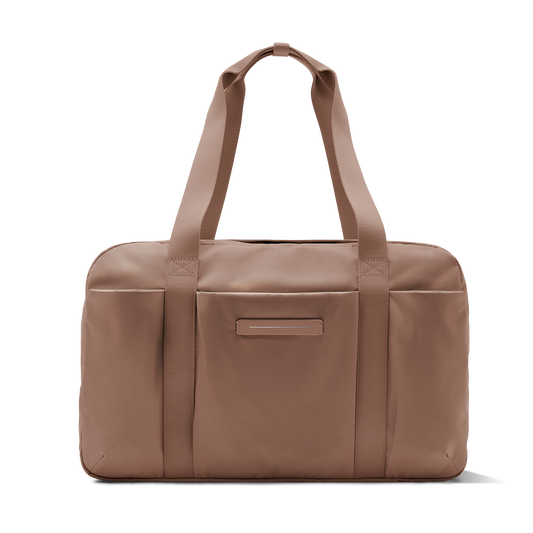
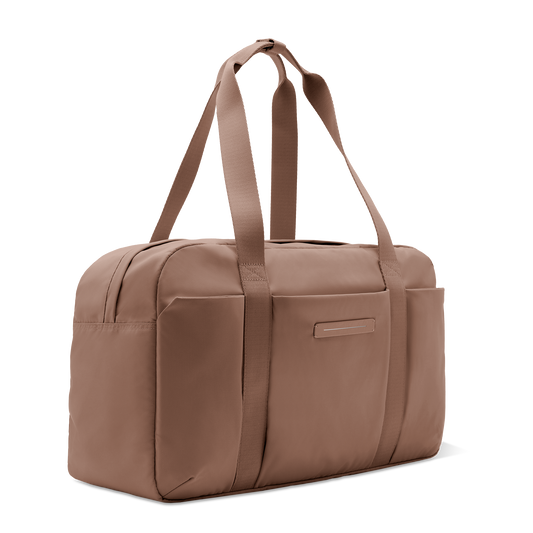
The Shibuya Rolltop Backpack weighs 655 grams and expands from 22 to 27 litres — a single, simple object that handles a working day and an unscheduled overnight without needing to change. The Shibuya Weekender brings the same logic to a weekend bag at 530 grams empty, with the kind of finish that reads as expensive without ever showing a logo. Both are the bags to reach for when the trip wants to disappear into the background.
GO Series: the case in its plainest form
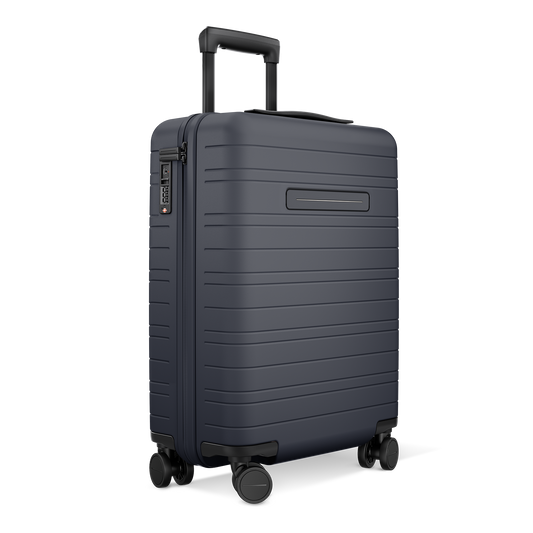
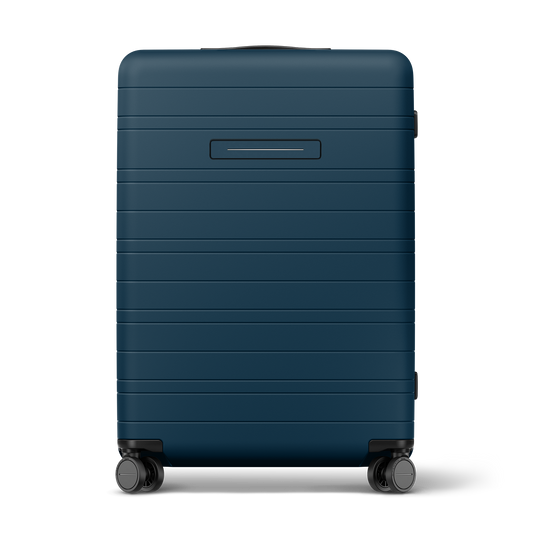
A minimalist suitcase is, paradoxically, the hardest kind to design. Anything ornamental gives the case away; anything austere can read as cheap. The GO Series is what happens when neither mistake is allowed. Premium polycarbonate, dark slate, timber wood, or river blue, dual mesh dividers, silent spinner wheels, no decoration. It is the most reduced suitcase Horizn makes — and at the most accessible price in the range, which is part of the point.
The H5 GO is the cabin case for two-to-five-day trips. The H6 GO is its check-in counterpart for trips of five to ten days. The H7 GO is the largest, for longer journeys where space matters and decoration still does not. None of them try to look like anything in particular. That is what makes them belong in the aesthetic.
How it expresses on the road
The aesthetic is not only in the objects. It is in the way they are used. A minimalist traveller arrives at a hotel and unpacks into the same five places every time: bag on the rack, charger in the most accessible socket, toiletries lined up at the sink, two layers hung in the wardrobe, paperback on the bedside table. The room looks lived in within four minutes and stays that way for the duration of the stay.
They take the same kind of photographs — long shadows on a wall, a single coffee on a clean table, the corner of a building seen from a tram. They walk slowly through neighbourhoods rather than ticking lists. They eat where the locals eat at the time the locals eat. None of this is performance. It is what is left when the noise has been turned down far enough.
The bag is the part of this you can buy. Everything else is practice.
Minimalist travel aesthetic FAQ
What is the minimalist travel aesthetic?
A travel style defined by reduction rather than display: a narrow palette of neutrals, a small wardrobe of well-made pieces, unbranded luggage in matte materials, and a slower way of moving through cities. It draws on Japanese, Scandinavian, and modernist European design traditions and emphasises calmness, restraint, and quality over variety.
What colours work for minimalist travel?
Black, dark slate, ink, off-white, and one personal neutral such as grey, olive, or stone. The palette is kept narrow on purpose so that every garment, bag, and accessory works with every other. Saturated colours are used sparingly, if at all.
What kind of luggage fits a minimalist aesthetic?
Hard-shell suitcases in matte black or dark slate without visible branding, paired with structured bags in recycled nylon, technical canvas, or fine leather. The Horizn GO, Gion, and Shibuya lines are designed in this register.
Is minimalist travel the same as travelling light?
They overlap but are not the same. Travelling light is a practical decision about weight and volume. The minimalist aesthetic is a decision about taste and tone. Most minimalist travellers also travel light, but the reverse is not always true.
Where does the minimalist travel aesthetic come from?
Its roots are mainly Japanese and Scandinavian — Tokyo, Kyoto, Stockholm, Copenhagen — with later influence from Berlin, Lisbon, Milan, and Antwerp. It draws on traditions that prize restraint, natural materials, and well-made objects with long service lives.



 New
New
 New
New